
What makes it an ultralight sleeping bag
For the sake of this guide, we consider any sleeping bag for backpacking that is comfort-rated down to freezing and weighs less than 24 oz in standard/medium/regular sizing to be an ultralight sleeping bag. However, there is no technical definition, and weight benchmarking is also relative to the temperature rating that you are shopping.
For 30 degree bags, we might consider the cut off to be 20 oz since they require less materials. And for 10 degree bags, closer to 30 oz, since they require more down, more fabric to contain the down, and extra interior space to layer.
Why focus on 20 degree sleeping bags for backpacking
For ease of comparison, this buyer’s guide focuses exclusively on 3-season sleeping bags for backpacking with 15-20 degree ratings in their product name. This translates to a 25-30 degree lower comfort limit, which we feel is the most useful, all-purpose insulation level which provides a few degrees of buffer below the lowest temperatures most backpackers will experience in a season.
However just about any sleeping bag for backpacking can also be purchased in 0, 10, and 30 degree versions, and the same recommendation qualifiers apply when comparing models. Unsurprisingly, the best overall 20 degree backpacking sleeping bag is also the best overall 30 degree backpacking sleeping bag.
Warmth-to-weight ratio is key for ultralight sleeping bags
Sleeping bags for backpacking have one main job – keep us warm. And so long as they’re doing that, the next most important thing is not to weigh down the backpack when carried.
That’s why our guide focuses on warmth-to-weight ratio as the ultimate measure of performance for backpacking sleeping bags. We’ll pass on all of the bells and whistles, so long as you give us a high warmth-to-weight sleeping bag at a good price.
Most features are nice, but not necessary
While significantly less important than having a good warmth-to-weight ratio, other features are worth considering to evaluate the entire user experience. Zipper snag guards, and the ability to cinch down around your head or neck are the two most important. But beyond that, which are worth their weight is fairly subjective.
Convertible blankets are very nice, especially in summer. We usually prefer a sleeping bag for backpacking wit a sewn footbox to ventilated ones for maximizing warmth-to-weight. But an exception would be made for 30 degree summer backpacking sleeping bags. Internal pockets are generally unnecessary, and we rarely go for draft collars except when winter camping.
Zpacks raises the bar for ultralight sleeping bags
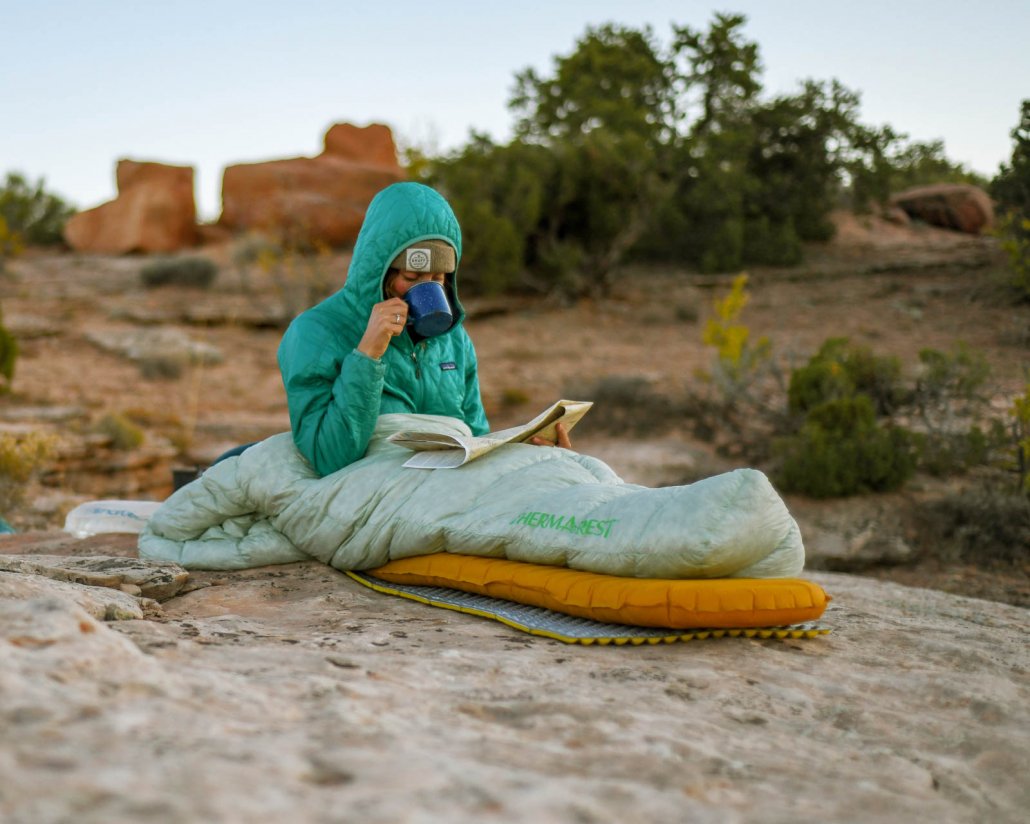
And speaking of the very best, you will notice that three of our favorite ultralight sleeping bags, including our top pick, are manufactured by one brand – Zpacks. Applying strict ultralight design methodology, Zpacks has created a range of sleeping bags for backpacking with objectively higher warmth-to-weight ratios than their competitors and completely raised the bar when it comes to performance and versatility.
To rate any other ultralight sleeping bag above theirs would be dishonest gear reviewing, and we sing their praises loudly and proudly. Go Zpacks!
Down and fill power
High quality down plumes are the most important part of a backpacking sleeping bag’s ability to loft and insulate. Down plumes are rated according to the amount of square inch volume taken up by one ounce. 900+ fill power is considered the loftiest, highest quality, most expensive down.
A sleeping bag for backpacking with fill power ranging from 850-950 is considered good. Fill powers from 750-850 are mid-tier. 550-750 is now considered low grade.
We’ve even noticed 1,000 fill power down being used recently, and while this is a strict performance upgrade, we’re worried that the most voluminous plumes would also be most susceptible to damage with use over time, and quickly degrade to a 900 fill power level, thus making paying extra for it a poor long term investment.
Will higher fill powers continue to be offered as we get better at sifting the best plumes to the top? We will report back as we learn more.
Down vs synthetic insulation for backpacking sleeping bags
As of 2023, high fill power down (900+) still outperforms synthetic insulation in warmth-to-weight, which is why all of the best performing ultralight sleeping bags are still filled with plumes. But technology creeps forward, and every year brings us closer to the day when synthetics surpass down in terms of performance.
At time of posting, top tier synthetic insulation appears to be edging out low-to-mid-tier down fill power, and is creeping towards equalling 800 fill power. And when manufactured with recycled materials, synthetics are beginning to appear as the more ethical choice too. We’re keeping our eye on the development of synthetic insulation for backpacking sleeping bags, and will report back as developments occur in this niche.
Fabrics and ultralight sleeping bags for backpacking
The best ultralight sleeping bag fabrics are the lightest ones that reliably encase down, and are just durable enough for backcountry use. To maximize warmth-to-weight, it is important to minimize fabric, as it is a low contributor of insulation. Ripstop nylon still reigns supreme here, and we prefer it in 7 denier (7D). If you’re hard on gear, we recommend you find a sleeping bag for backpacking with a 10D+ Ripstop nylon.
Backpacking Sleeping Bag Baffles
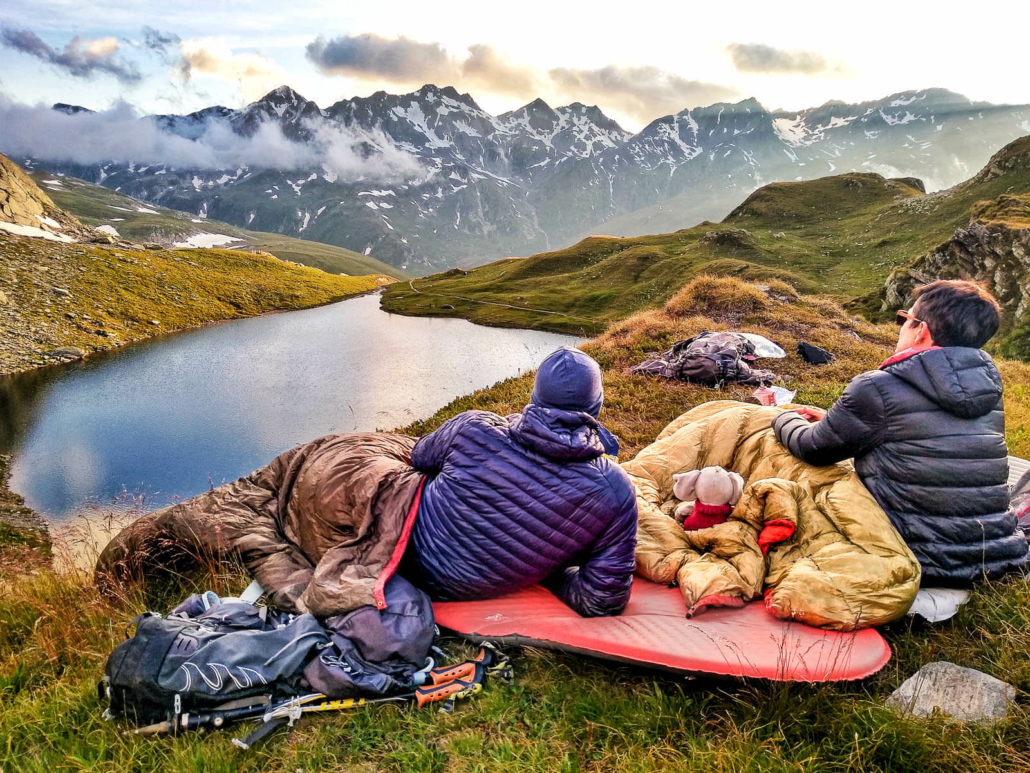
From a performance perspective, it is preferable to sew vertical baffles (paralleling the body) along the chest and legs of a sleeping bag. This is compared to horizontal baffles (running perpendicular to the body) in which gravity will slowly cause down plumes to drift off the top center of the body and down to the lower sides. This exposes a cold spot directly on top of the sleeper and must be prevented. This is a particularly egregious problem for side sleepers, who should make sure their sleeping bag for backpacking has vertical baffles from the hips up.
Ultralight Quilt > Ultralight Sleeping Bag
It is our long-held belief that the best ultralight quilt will easily outperform the best ultralight sleeping bag for backpacking in terms of warmth-to-weight, value, and overall user experience. Quilts are composed only of the three hardest working parts of a sleeping bag (top, sides, footbox) and cut the three least hard working parts (zipper, hood, back).
Compared to down and nylon, zippers are relatively heavy and provide no insulation. Compared to fully lofted down on the top and sides of a sleeping bag, down that is compressed underneath the weight of your body and hood is relatively ineffective. By doing away with zippers, backs, and hoods, camp quilts reduce production cost, save weight, shave the least effective components, and increase warmth-to-weight ratio.
When not testing a sleeping bag for backpacking, we always choose a quilt. But we understand why people love sleeping bags. The sensation of fully zipping up and tucking into the hood is cozy and hits just right. That’s why we fully endorse the ultralight sleeping bags in this guide. But if you want to crank up performance even higher, check out our buyer’s guide for the best ultralight quilts.
Hoodless Backpacking Sleeping Bags > Hooded
Similar to quilts but not quite as minimalist, we also like a hoodless ultralight sleeping bag chassis over traditional models. Along with the zipper and back, the hood is one of the three least hard working parts of a backpacking sleeping bag, and by removing it, the warmth-to-weight ratio is improved.
Maintaining an Ultralight Sleeping Bag For Backpacking
While unpacking from your trip, make sure to dry out and re-fluff your backpacking sleeping bag. We recommend running it through a front loading dryer on low for 10 minutes, or until dry. Store it in the big cotton bag it came with rather than compressed in a dry bag. If you notice that your sleeping bag is slowly losing loft, try washing it with Nikwax downwash.
With use over time dirt and body oils will slowly start to penetrate the fabric and build up on the plumes. This degrades their loftiness, thus decreasing the insulating ability of your sleeping bag. We find that washing resuscitates down up to 90% of its original off-the-shelf performance, and we try to do it about once every other year for high-use backpacking sleeping bags.
Conclusion Ultralight Sleeping Bags For Backpacking
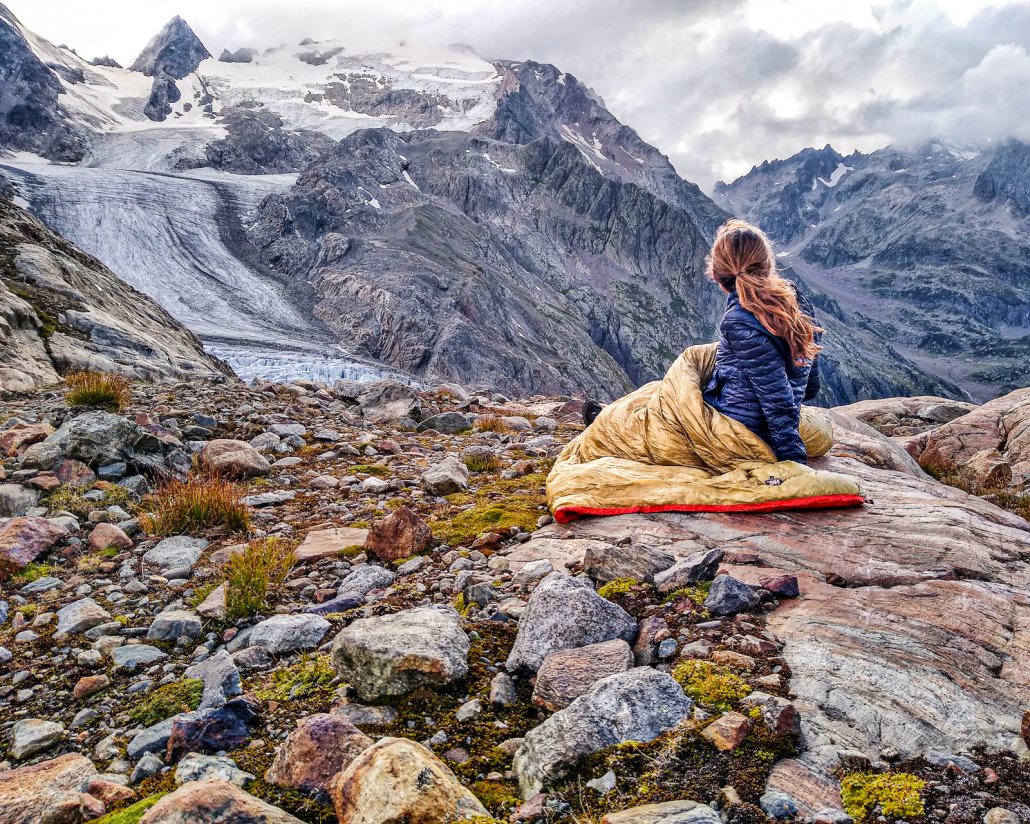
The best sleeping bag for backpacking is such because it has a high warmth to ratio, and a low total weight. The ultralight sleeping bags in this buyer’s guide have the highest warmth-to-weight ratios according to our predictive model. Ultralight sleeping bags from Zpacks are a notch above the rest in this way, and they manufacture all three of the best performing sleeping bags available.
But great bags are produced by a variety of brands, and at a variety of price points, and any one on this list would make for your next great backpacking sleeping bag.

