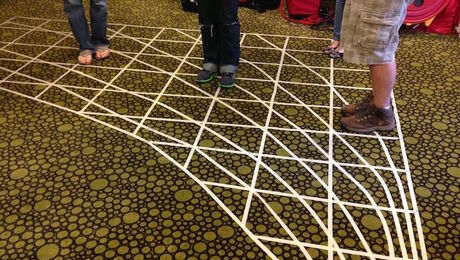
So you think you understand psychrometrics, eh? OK then. Let’s do a little quiz today and test your psychrometric knowledge. These questions include some basic stuff and some more complicated stuff about the subject, but you don’t need to use math to answer them. It’s not the same as playing Psychrometric Chart Simon Says (photo above), but it’s a good exercise.
Psychrometric fundamentals
Before we start, though, let me bring the uninitiated into the fold with some basics about psychrometrics. First, let’s define the term:
Psychrometrics – the science that involves the properties of moist air (a mixture of dry air and water vapor) and the processes (meteorological, air conditioning, drying, humidification, dehumidification, agricultural soil evaporation) in which the temperature and/or the water vapor content of the mixture are changed.
That definition is from the bible of psychrometrics, Understanding Psychrometrics by Donald Gatley. It’s a great book that covers the whole subject, including history, terminology, and more. It goes pretty deep and has a lot of math, so it’s not for everyone. I wrote a little series on psychrometrics a while back, and that might be a good way to go deeper.
In the old days, engineers used to design HVAC systems by using a psychrometric chart (below). It’s a visual representation of the relationships of the psychrometric variables. Nowadays, the chart is more of an educational tool. Engineers use computer programs or apps to do numerical work in psychrometrics.
You can use the chart shown above as an aid to answering the questions below. Also, one of the questions below relies on a numbering scheme for the surfaces in a double pane window. That system also applies to a single pane window with a storm window. Here’s the scheme:
- Outer surface of outer pane (You can touch it from outside the house.)
- Inner surface of outer pane (between the two panes but on the outer pane)
- Outer surface of inner pane (between the two panes but on the inner pane)
- Inner surface of inner pane (You can touch it from inside the house.)
Ready to see how well you understand psychrometrics? Here we go.
A psychrometric quiz
1. On a cold rainy day, outdoor air leaks into a house and warms up to room temperature. What happens to the indoor relative humidity?
2. A double-pane window develops a leak that allows humid air to get into the space between the panes. Which surface is most likely to have condensation on it in summer? (Use the numbering scheme above.)
3. You walk outside and your glasses fog up. What time of year is it?
4. Your car’s windshield fogs up on the inside in winter. What’s the best way to clear it?
5. Can outdoor air in the southeastern U.S. dry out a vented crawlspace in the summer?
6. What happens to the dew point temperature when the dry bulb temperature increases while the water vapor concentration remains constant?
7. Can relative humidity go higher than 100%?
8. An air conditioner in Miami, Florida, cools and dehumidifies the air. What do you know about the relative humidity of the air right after it comes through the cooling coil?
9. What happens to the dew point temperature when the relative humidity stays constant while the dry bulb temperature increases?
10. Have you or anyone you know experienced conditions of 100°F (38°C) and 90% relative humidity?
The answers
You’re not looking ahead without putting forth a good effort to answer those questions, are you? If so, go back and write down some answers.
I’ll wait.
Done?
Well, go do that last one. Don’t you really want to understand psychrometrics?
I’m giving you plenty of opportunity to avoid accidentally seeing the answers here.
OK, here you go.
1. It drops. For example, 32°F (0°C) outdoor air at 100% relative humidity will drop to ~20% when heated to 70°F (21°C). See more in my article on cold air and humidity.
2. Surface 3. If the indoors is air conditioned, it’s going to stay consistently cooler than the outer pane of glass.
3. Summer in a humid climate. Humid outdoor air meets cool glasses.
4. Blow heated air at the windshield with the air conditioner running and the system set to fresh air, not recirculate. For even more dehumidification, open the car windows. See my article on that topic for full details.
5. Nope. It often leads to higher relative humidity. Details here.
6. If the water vapor concentration doesn’t change, the dew point also doesn’t change. (Well, I didn’t say anything about barometric pressure, so we’re assuming it’s constant. If it changes, too, then the dew point temperature can change.)
7. Yep. If there’s nothing for the water vapor to condense onto, you can get supersaturated air at higher than 100% relative humidity.
8. It’s going to be very high, maybe even close to 100%. But it dries out the indoor air because it has a lower dew point. When it mixes with the rest of the indoor air and warms up to room temperature, the relative humidity drops. See the answer for question 1.
9. To maintain constant relative humidity at higher temperatures, you have to have more water vapor in the air. That causes the dew point to increase.
10. Not on Earth in any outdoor weather conditions ever recorded. The dew point temperature for those conditions would be 96.5°F (36°C). The highest recorded dew point is 95°F (35°C). More on that topic here, with US dew point records, too. Now, it’s possible you or your friends could experience a dew point temperature higher than the world record, but you’d be in a sauna.
There you have it. If you understand psychrometrics, you should have gotten at least 7 out of 10 right.
________________________________________________________________________
Allison A. Bailes III, PhD is a speaker, writer, building science consultant, and the founder of Energy Vanguard in Decatur, Georgia. He has a doctorate in physics and is the author of a bestselling book on building science. He also writes the Energy Vanguard Blog. For more updates, you can subscribe to our newsletter and follow him on LinkedIn. Images courtesy of the author.
Weekly Newsletter
Get building science and energy efficiency advice, plus special offers, in your inbox.